
The first time I climbed into the front seat of a tuk-tuk, I stalled it five times before I could get it moving. There was nothing remotely familiar about any of it. Sarah sat behind me with her eyes closed, just hoping I wouldn’t stall in the middle of an intersection again.
A week later, we were driving our little blue three-wheeler through tea plantations above Kandy, 750 kilometers into a route we’d mapped entirely ourselves.
It became one of the best things we’ve ever done while travelling.
We spent two months in Sri Lanka and rented a tuk-tuk for the first two weeks of it. In that time, we covered Negombo, Dambulla, Sigiriya, Anuradhapura, Wilpattu, and Trincomalee.
We understand the hesitancy… it’s an unfamiliar vehicle, in an unfamiliar country, with genuinely chaotic traffic. So this is everything we wish we’d known before we picked up the keys, including the parts that most people skip over!

Our First Time Renting & Driving a Tuk-tuk
When I first climbed into the front seat of the tuk-tuk, I immediately felt intimidated. I (Caleb) grew up riding dirt bikes, four-wheelers, and dune buggies, but this felt very different.
There was very little resemblance to what I’d driven before. The throttle and the gear shift were both on the left side of the handlebars, the clutch on my right, and only a foot brake at my feet.
I stalled out the first five times I tried to start, and although I eventually figured it out toward the end of my driving lesson, I still didn’t feel super confident, especially when our first task was a five-hour trip to Dambulla.

I still remember Sarah closing her eyes through the wild traffic in Sri Lanka, just praying I wouldn’t stall in the middle of an intersection… again.
But after a few days, I’d gotten the hang of it and felt really confident driving our little blue tricycle around the city. It became more exciting than daunting, and we absolutely loved it!
How long did we rent a tuk-tuk in Sri Lanka?
We reserved a tuk-tuk rental for our first two weeks in Sri Lanka (15 days, to be exact). We were hesitant to commit to a full two months without having done it before.
In the end, that was the right decision for us.
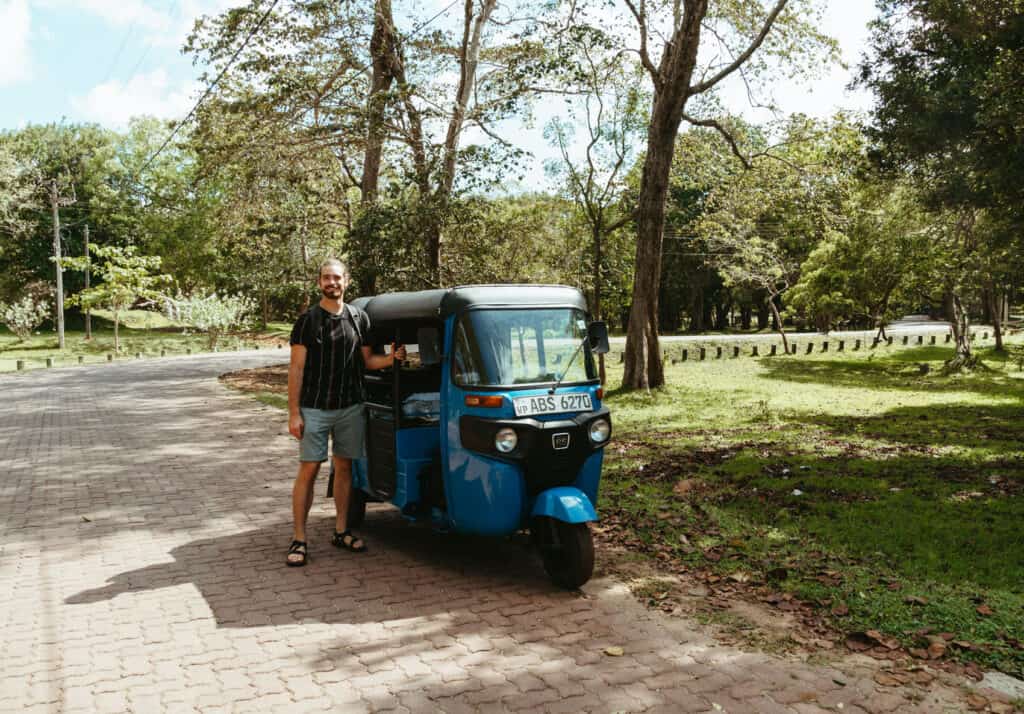
This came down to cost and efficiency. While it isn’t insanely expensive, there are definitely cheaper ways to travel around Sri Lanka, and we frankly didn’t have the budget to rent our tuk-tuk for the entire two months. Two weeks was a fair compromise.
Another reason this was a good decision is that tuk-tuks are extremely slow, with a max speed of 40 KPH (25 MPH). This made every trip between cities a full-day excursion.
Where did we go in our tuk-tuk?
After spending a few days in the capital of Colombo, we took a taxi up to Negombo (right next to the airport) to pick up our tuk-tuk.
From there, we drove our little blue three-wheeler over 750 kilometers in total! We went from Negombo to Dambulla, Sigiriya, Anuradhapura, Wilpattu National Park, Trincomalee, Kandy, and many other small towns across northern Sri Lanka.
A Suggested Two-Week Tuk-Tuk Route
Two weeks is the sweet spot for a first tuk-tuk trip. It’s enough time to cover the cultural triangle, the east coast, and the hill country without rushing, and it keeps costs manageable. Here’s roughly the route we’d recommend based on our own experience:
- Negombo (Days 1–2): Pick up the tuk-tuk here, get your driving lesson, and spend a day getting comfortable on quieter coastal roads before committing to a long drive.
- Dambulla (Day 3): About a four-hour drive inland. Stay near the famous cave temples and use it as a base for Sigiriya the next morning.
- Sigiriya (Days 4–5): Climb the rock, explore Pidurangala, and enjoy some of the most dramatic scenery in Sri Lanka. The roads around here are beautiful tuk-tuk territory.
- Anuradhapura (Days 6–7): The ancient capital. Budget at least two days here because the archaeological site is huge and best explored by tuk-tuk or bicycle.
- Trincomalee (Days 8–9): Head northeast for beaches, whale watching season (April), and the stunning Koneswaram Temple. One of the longer drives (roughly five hours), so start early.
- Kandy (Days 10–12): The cultural heart of Sri Lanka, with great coffee and some of the coolest attractions in Sri Lanka. This is where the roads start to get steep and our tuk-tuk was FEELING IT on the way up to our gueshouse in Kandy!
- Drop-off (Days 13–15): Either drive back to Negombo (free return) or pay the drop-off fee to end your trip in Kandy or another city. We paid $90 USD to drop off in Kandy and thought it was worth not spending an entire extra day on the road.
Total driving distance for this route: roughly 700–800 KPH (435–500 miles) depending on detours. Plan for five to seven hours of driving on the longer legs, and always leave early to make the most of daylight.
Why We Used Tuktukrental.com
You can rent a tuk-tuk almost anywhere in Sri Lanka. There are quite a few rental agencies these days, and more are popping up each year.
But after a lot of research, we decided to go with tuktukrental.com.
They seemed to be the most reliable option and had really good reviews. We also loved that they’re a social enterprise: they don’t own any tuk-tuks themselves, but instead rent vehicles from local Sri Lankan families and pay them up to five times what they’d otherwise earn. It’s a genuinely cool model.
Here are some more benefits we got with tuktukrental.com:
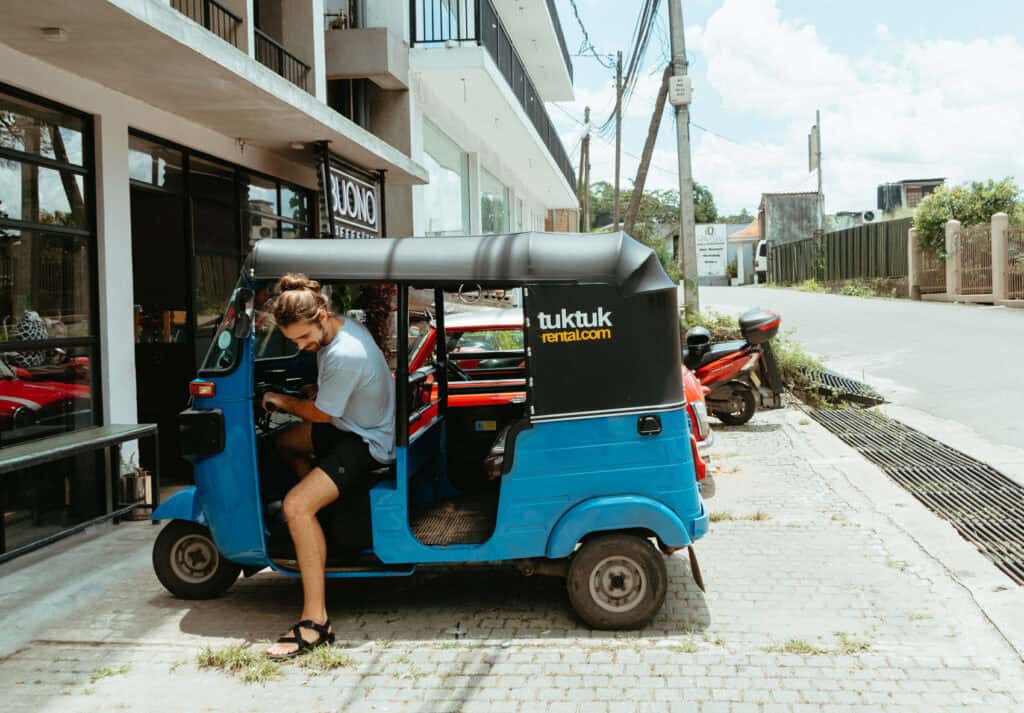
Insurance
Tuktukrental.com includes standard motor insurance with every rental, but it’s worth knowing that the standard policy comes with a $150 USD excess, so if there’s a minor bump or scratch, that’s your responsibility up to that amount.
If you want full peace of mind, they offer an optional ‘Peace of Mind Cover’ add-on that removes the excess entirely. For most people, the standard policy is fine, but it’s worth considering if you’re a nervous driver or heading into the hill country.
24/7 Support
We broke down twice in Sri Lanka. In both cases, the staff was extremely helpful. They helped us find a mechanic, spoke on our behalf, and reimbursed us for the parts and labor needed to fix our tuk-tuk. They also added us to a private WhatsApp group with other customers on the road in Sri Lanka so we could get real-time updates about what’s happening in different parts of the island.
Free Driving Lesson
The driving lesson is crucial because you haven’t driven a tuk-tuk before. They’ll stay with you until you’re comfortable enough to hit the road on your own, which typically takes about an hour. This was incredibly helpful for me since I wasn’t used to a manual transmission.
Vehicle Options
Most companies now offer three types of tuk-tuk:
- Standard RegularTuk (what we had)
- CabrioTuk (an open-sided soft-top version, great for coastal roads)
- ElectricTuk (zero emissions, quieter ride).
The Cabrio and Electric models are popular, so book early if you have a preference, especially in peak season (December to April and June to October).

Accessories + Add-ons
All of the tuk-tuks come with a phone holder and USB charger, reserve fuel, a spare tyre, and access to their travel app with over 1,000 off-the-beaten-track locations. You can also add Bluetooth speakers, a cooler, a surfboard rack, a baby seat, and more for an additional fee.
What Licence Do You Need to Drive a Tuk-Tuk in Sri Lanka?
IMPORTANT UPDATE (January 2026)
The Automobile Association of Ceylon (AAC) has updated its requirements.
You now need THREE documents to legally drive a tuk-tuk in Sri Lanka. Digital IDPs (e-IDPs) are NOT accepted. Read the full breakdown below and get your IDP sorted well before you travel.
This is probably the most important section of this entire post, so pay close attention.
As of January 2026, to legally drive a tuk-tuk (or any vehicle) in Sri Lanka as a foreign tourist, you need three documents in hand:
- Your valid home country driving licence
- A physical International Driving Permit (IDP), issued under the 1949 Geneva Convention
- A Sri Lankan Recognition/Covering Permit, issued by the Automobile Association of Ceylon (AAC) or arranged through tuktukrental.com
All three are mandatory. You can’t skip any of them.
What is an IDP and How Do You Get One?
An International Driving Permit (IDP) is a document that translates your home country licence into multiple languages and is recognised internationally. It’s not a replacement for your licence, but a supplement to it.
The key thing to know: it must be a physical, printed IDP issued under the 1949 Geneva Convention standard. Digital or electronic IDPs (e-IDPs) are not accepted by the AAC and will not work. The IDP is obtained from your home country before you travel. The cost and process vary by country, but it’s usually just a few days and somewhere around $20.
The Sri Lankan Recognition/Covering Permit
Once you have your IDP and your home country licence, you need the Sri Lankan Recognition/Covering Permit. This is the local document that allows you to drive on Sri Lankan roads.
You have two options:
- Do it yourself: Visit the AAC office in Colombo. Bring your home country licence, your physical IDP, your passport, and passport photos. Budget around half a day and the permit costs roughly $20 USD at the office.
- Let tuktukrental.com handle it: They can organise the permit on your behalf before you arrive. The service costs $40 USD per licence and takes up to two working days. You can request this when making your reservation. Honestly, it’s worth every dollar to avoid the admin hassle.
The permit is valid for up to three months.
How much Does a Tuk-tuk Rental cost?
If you don’t know where to look, renting a tuk-tuk in Sri Lanka can feel pricey compared to other transportation options. Here’s what to expect with tuktukrental.com:
Prices vary depending on the time of year, rental duration, and the type of tuk-tuk (the Cabrio and Electric models cost more than the standard RegularTuk).
Most companies publish their full tiered pricing (broken down by vehicle type and rental length) directly on their website.
Because rates change seasonally, we’d rather link you there than quote a figure that might be out of date by the time you’re booking, but base prices currently range from $14 to $28 USD per day depending on duration, and longer rentals get meaningfully better rates.
Shoulder season (typically April to May and November) tends to bring lower rates and they were running a special for April when we rented ours for two weeks at just $14/day.
You’ll also want to budget for a few additional costs:
- Recognition/Covering Permit: $40 USD if handled by tuktukrental.com, or around $20 USD if you do it yourself at the AAC.
- Refundable deposit: $150 USD, returned within seven days of returning the tuk-tuk in good condition.
- Drop-off location change: Variable. Returning the tuk-tuk to a different city from where you picked it up costs extra. We paid $90 USD to drop ours off in Kandy instead of Negombo.
Petrol: Very cheap. We spent less than $25 USD for 750 kilometers over two weeks.
Luckily, they were running a special for the shoulder season (April/May), and we rented ours for two weeks at just $14/day.
However, you’ll probably have to account for some additional expenses, such as;
After all of our additional expenses, we spent $380 USD ($26/day) to rent our tuk-tuk for 15 days. If we’d returned it to Negombo instead of paying the drop-off fee, it would have been around $290 USD total ($18.50/day).
Can I Get A Discount?
Yes! After genuinely loving our experience with tuktukrental.com, we’ve partnered with them to offer readers a discount on bookings.
Use this link for 5% off your entire booking (automatically applied at checkout).
Pros and Cons of Renting a tuk-tuk
Pros
Ultimate Freedom: Having your own transportation means you’re never tied down to a specific itinerary. You can change the plan without feeling locked into a train schedule or guided tour. (although there are perks to day trips from places like Colombo).
Once-in-a-lifetime experience: We aren’t exaggerating when we say driving a tuk-tuk around Sri Lanka is something you’ll talk about for the rest of your life. We’ve never regretted it.
Easy Packing: With our tuk-tuk, it was easy to throw our 40L travel bags and daypacks in the back and head to the next guesthouse. No squeezing luggage onto a motorbike.
Rain cover: Once we gave up our tuk-tuk and switched to a motorbike, we got caught in the rain constantly. Even with ponchos, it still sucked. The tuk-tuk’s rain covers on each side make a real difference.

Cons
Very slow travel: Most major tourist towns in Sri Lanka are three to five hours apart by tuk-tuk, making for long travel days if you’re trying to cover a lot of ground.
Accidents do happen: The traffic in Sri Lanka is wild, and while we’d hesitate to call it outright dangerous, it’s not without risk either. There are no seat belts in a standard tuk-tuk.
Not very powerful: Tuk-tuks struggle on steep hills, especially in the rain. Getting up to our guesthouse in Kandy sometimes meant unloading our luggage so the engine could make it.
Corrupt policemen: We didn’t get pulled over, but we’ve heard of other travellers getting stopped for random licence checks and being asked to pay a small ‘fine.’ It’s not common, but worth knowing about.
What You Might Not Expect
We had our assumptions about what driving our tuk-tuk through Sri Lanka would be like, and some of those were completely different than we expected. Here’s what surprised us…
You’ll see so much wildlife!
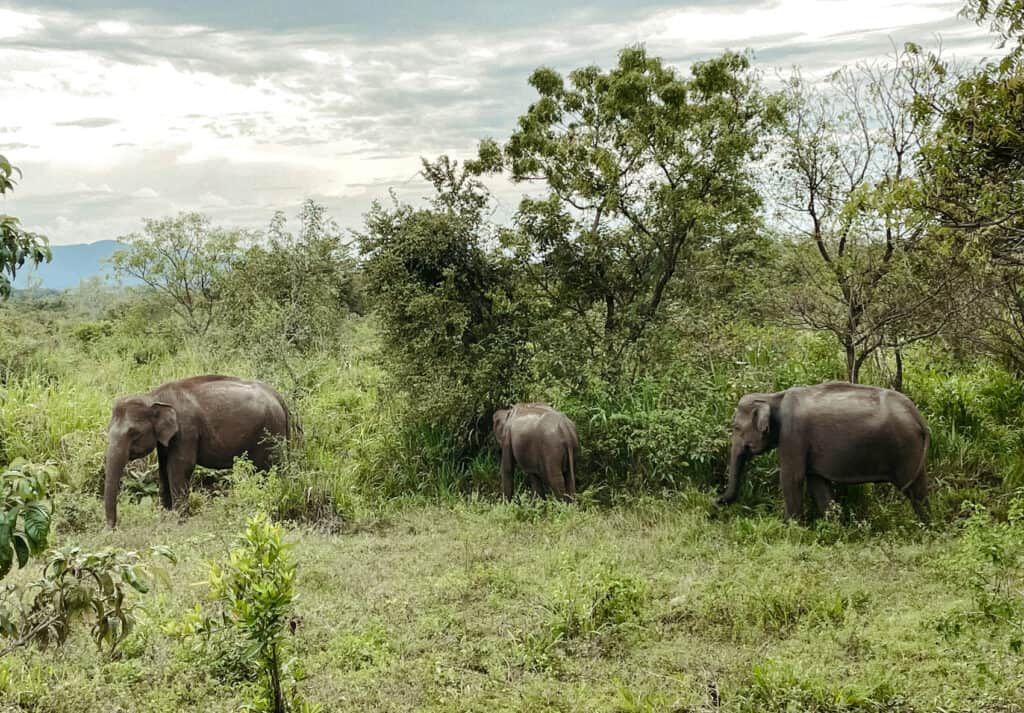
Sri Lanka is full of wildlife. We saw wild elephants, water buffalo, peacocks, and all kinds of other animals all over the island, and we didn’t even have to go on an official safari (though you should).

We’d just be driving along the main highway and suddenly a family of elephants would be crossing the road.
They are SLOW
Throughout Sri Lanka, the maximum speed for tuk-tuks is 40 KPH (25 MPH). You won’t really notice this in the cities, but it takes forever to travel from one city to the next.
No major highways/toll roads
In addition to the special speed limit, tuk-tuks are not allowed to use major highways on the island.
There aren’t a lot of toll roads inland, but it will force you to detour around Colombo or in cities on the South Coast, such as Galle, Weligama, and Ahangama.
Turn off the motorway options on Google Maps as soon as you pick up the tuk-tuk.
You will probably break down
We had two small mechanical problems with our tuk-tuk. The first was with the brake pads (worn down to almost nothing). The second was a clogged valve that caused the engine to cut out repeatedly between Anuradhapura and Trincomalee.
Both were annoying in the moment, but finding a mechanic was easy, and everyone was incredibly helpful.
Tuktukrental.com also reimbursed us (although it was only 500 LKR ($2) to fix it both times).
Mountains can be a challenge
If you take your tuk-tuk into the mountains of Sri Lanka, it has to work really hard to get up steep hills.

It CAN make it. We made it up some pretty steep hills, even when we had our luggage, but it’s tough on the motor and makes the journey even slower than it already is in a tuk-tuk.
So, just be aware of this and plan ahead when visiting places like Nuwara Eliya and Horton Plains National Park and driving to some of the hiking trails in Ella.
manual transmission
I don’t know why we didn’t expect this, but all tuk-tuks are manual vehicles. We assumed it would be similar to renting a scooter (which is generally automatic). After some practice, we were able to manage, but it still took a little while before we really felt comfortable driving the tuk-tuk.
Essential Tips for Driving in Sri Lanka
Use the horn liberally
In Sri Lanka, the horn isn’t aggression, it’s communication. Tap it when overtaking, when coming around a blind corner, or when a dog is sitting in the road (which happens constantly). You’ll hear locals doing it constantly. Do the same and you’ll fit right in and stay safer.
Turn off motorways on Google Maps immediately
Tuk-tuks are not allowed on Sri Lanka’s expressways, and Google Maps doesn’t automatically know you’re in a tuk-tuk. The very first thing you should do after picking up your vehicle is go into Google Maps settings and turn off motorways/toll roads.
This saves you from following a route that dead-ends at a highway you can’t legally use. This catches almost every first-time renter off guard around Colombo.
If you get pulled over by police
We didn’t get pulled over ourselves, but it does happen to foreign tuk-tuk drivers. The advice we heard consistently: stay calm, have all three documents ready (home licence, physical IDP, and AAC covering permit), and don’t hand over originals until you’re sure you’ll get them back. If a ‘fine’ is requested that has no paperwork attached to it, it’s almost certainly a shakedown.
The Kandy to Ella train: do you have to skip it?
The Kandy to Ella train is one of the most celebrated train journeys in the world, and the fear of missing it is one of the most common reasons people hesitate to commit to a tuk-tuk rental. The good news is that you don’t have to skip it.
Some companies (like tuktukrental.com) offer a paid service where they transport your tuk-tuk (and your luggage) between the two points while you ride the train.
Wildlife on the road
Elephants, water buffalo, peacocks, monkeys, and the occasional cow will all appear on the road without warning. The rule is simple: slow right down, give them space, don’t use the horn around elephants (they can charge), and enjoy the moment. This is one of the genuinely magical parts of the tuk-tuk experience that you simply don’t get on a bus or in a taxi with blacked-out windows.

Is it safe to drive a tuk-tuk in Sri Lanka?
This is a really tricky question because there are obviously risks with driving any vehicle, anywhere in the world.
There are no seat belts in a tuk-tuk, and if you end up in a collision with a larger vehicle, the tuk-tuk’s light frame will lose that fight. So, it’s not something to take lightly.
But it shouldn’t stop you from renting a tuk-tuk.
They’re only involved in 6% of fatal accidents in Sri Lanka, and for drivers following the rules of the road, that’s even less.
What are road conditions like?
We were surprised to find the road conditions in Sri Lanka exceptional. Everything was really well-maintained, even in the more remote towns or on backroads to waterfalls and hiking trails.
There were some specific spots like Secret Beach in Mirissa or climbing to Single Tree Hill in Nuwara Eliya, but these were the rare exceptions!
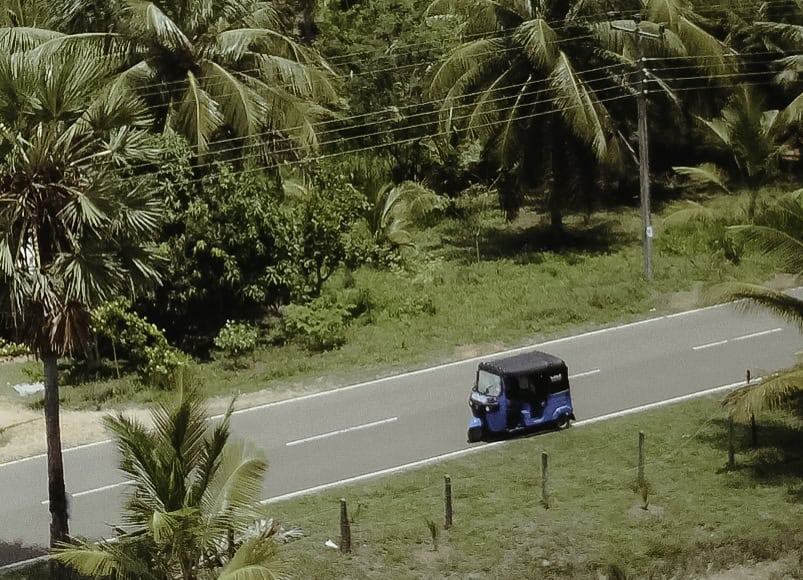
What if you break down on the road?
We already covered that we broke down twice in our tuk-tuk. In both cases, we were overwhelmed by the hospitality of the Sri Lankan people.
This was a theme throughout our trip through Sri Lanka, but specifically when we broke down, it seemed people would drop everything to help us.
We even met a man at the gas station who helped us get our tuk-tuk to his local shop and then fixed it for free! When we offered him money, his response was, “No, I have money. I just hope you enjoy Sri Lanka.”
How many people can fit in a tuk-tuk?
A tuk-tuk comfortably accommodates three people (including the driver). Behind the passenger seat, there’s also enough space to fit two small suitcases or travel bags.
What side of the road do they drive on?
Sri Lanka drives on the left side of the road. We’ve gotten used to this while spending time in Bali, Thailand, and England. But if it’s your first time, it could take some getting used to!
The Verdict – Is renting a tuk-tuk worth it?
Yes, 100%.
Renting a tuk-tuk is a once-in-a-lifetime opportunity that’s worth every penny. There are cheaper ways to get around, but nothing else gives you this level of freedom, spontaneity, and honestly, just pure fun.
It also makes you a lot more flexible when taking day trips from the major cities or visiting the more remote waterfalls in Sri Lanka.
You don’t have to rent one for the entire trip either. You could do something similar to what we did and rent a tuk-tuk for just a portion of the trip. That’s easy with tuktukrental.com because they offer pickup and drop-off in almost every major tourist town across the island.
Just make sure you get your IDP sorted well before you travel. Given the January 2026 licensing update, it’s the one thing that could derail your plans if you leave it too late.
Ready to book? Use this link to get 5% off your tuk-tuk rental (automatically applied at checkout).


